
How to Write a High-Converting Homepage for Your Therapy Practice
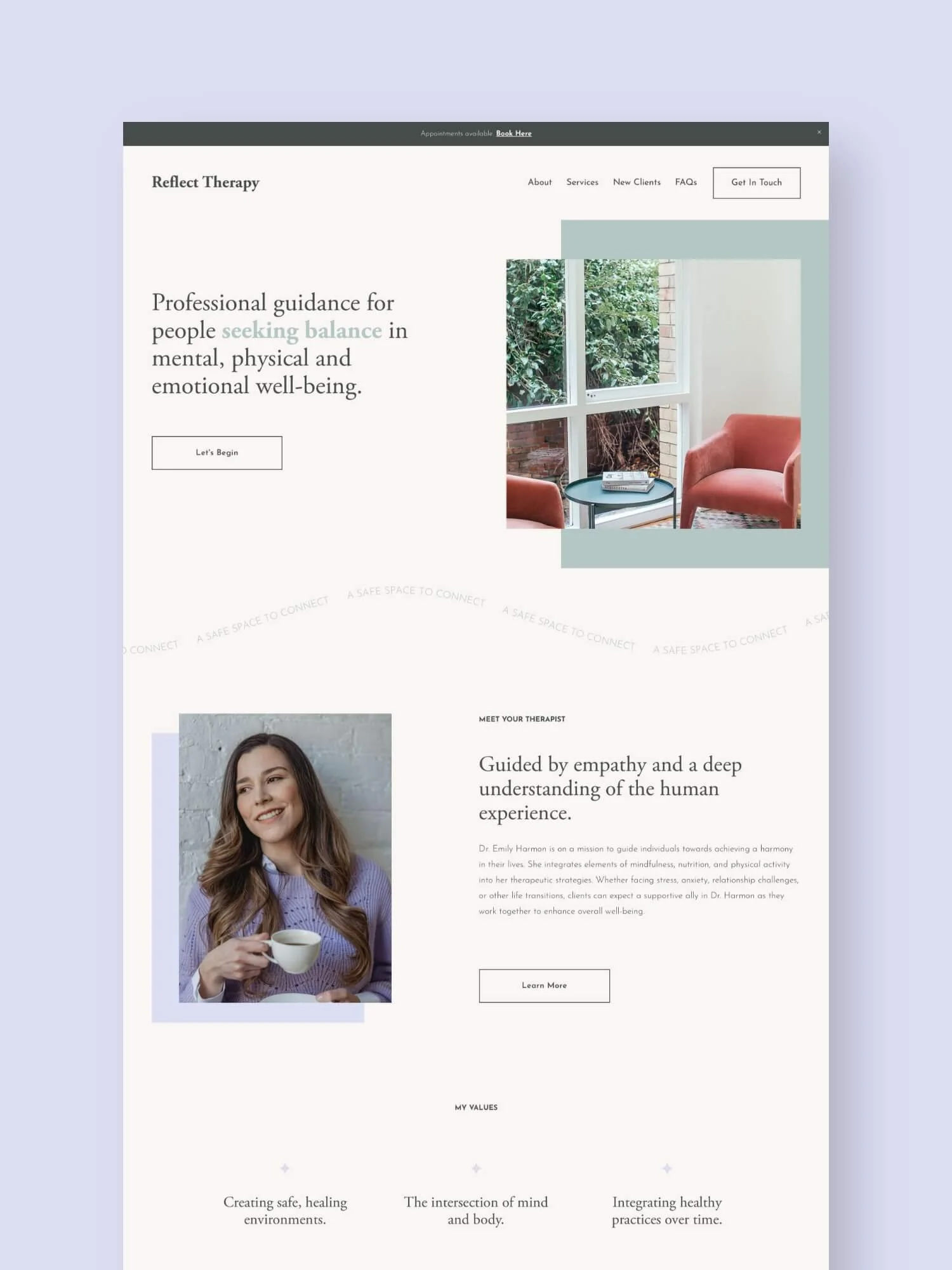
Check out our Squarespace template for therapists
If you run your own practice and are struggling with your website, this is for you! Below, I break down what a successful homepage looks like for therapists. You can refine and tweak these sections to fit your brand, but the most important thing is the structure, the sequence, and the intent behind each section.
(Note: If you prefer a one-page website approach, this structure works perfectly for that, too!)
Section 1: The Hero (Your Positioning)
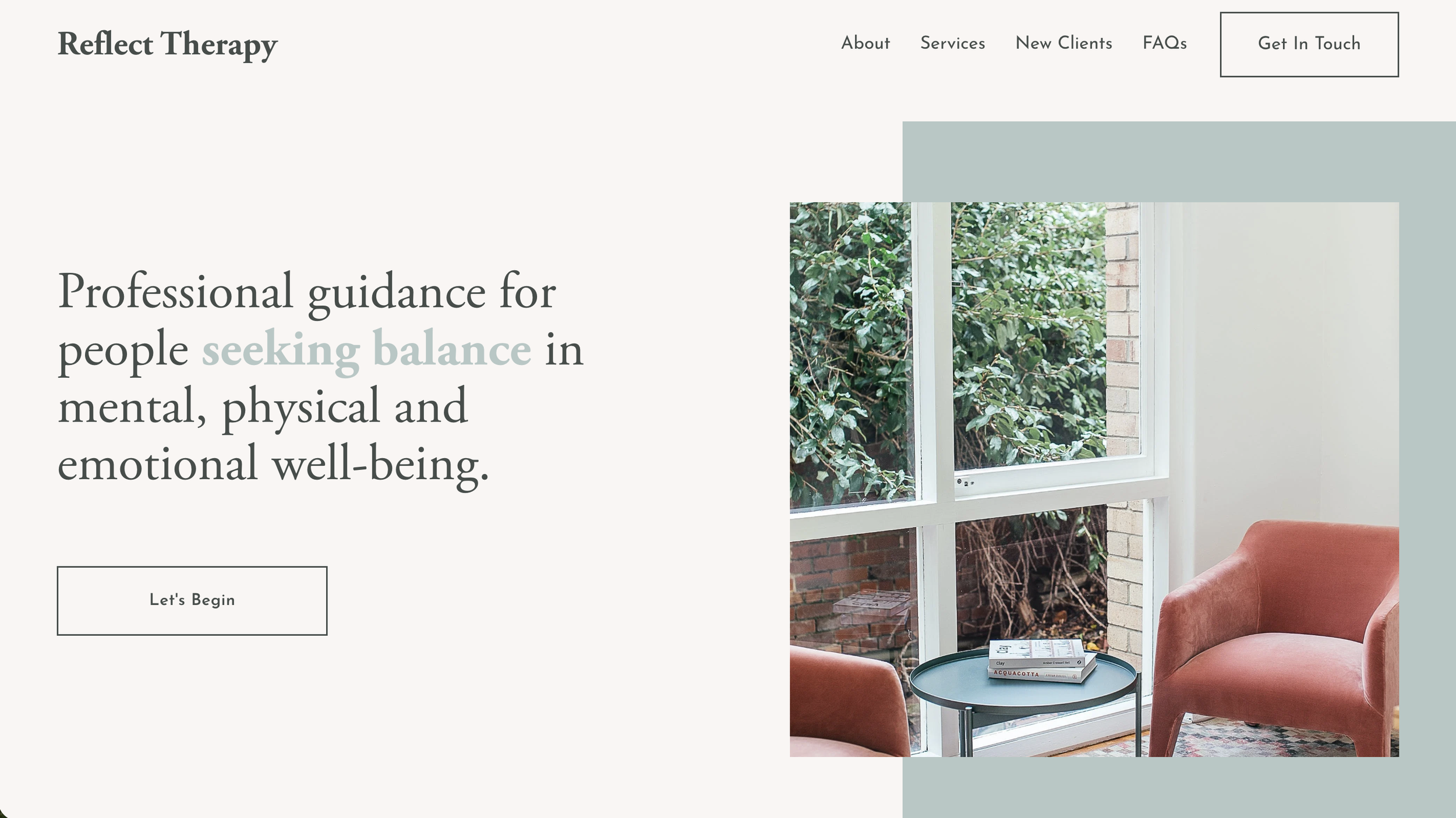
This is where you state your position. Your positioning statement is what you are known for (or want to be known for). It is the "elevator pitch" of your brand. For therapists, the challenge is balancing clinical expertise with approachable, human empathy.
Depending on your focus, here are four formats you can use:
1. The "Transformation" Format
Focuses on the shift from a negative state to a positive one.
Template: I help [Specific Audience] go from [Current Struggle] to [Desired State] through [Modality/Approach].
Example:I help high-achieving professionals go from perpetual burnout to sustainable work-life balance through Cognitive Behavioral Therapy.
2. The "Elimination" Format
Positions you as a specialist who removes a specific barrier.
Template: I provide [Service/Specialty] to help [Target Market] overcome [Specific Obstacle] so they can [Life Goal].
Example:I provide trauma-informed EMDR therapy to help survivors of childhood neglect overcome limiting self-beliefs so they can build healthy, secure adult relationships.
3. The "Identity-Based" Format
Best if your practice is built around a specific niche or community.
Template: As a [Niche] therapist, I support [Target Market] in navigating [Specific Challenge] using [Service/Style].
Example:As a neuro-affirming therapist, I support late-diagnosed ADHD adults in navigating executive dysfunction using strength-based coaching.
4. The "Simple Value" Format
Short, punchy, and perfect for website headers or Instagram bios.
Template:[Service] for [Target Market] looking to [Result].
Example:Compassionate grief counseling for young widows looking to rebuild a meaningful life after loss.
Pro-Tip: Make your [Target Market] as specific as possible. Instead of just "adults," try "anxious perfectionists" or "first-generation immigrants." The more specific the "who," the more magnetic the "why" becomes.
Section 2: The Personalization (Meet the Human)
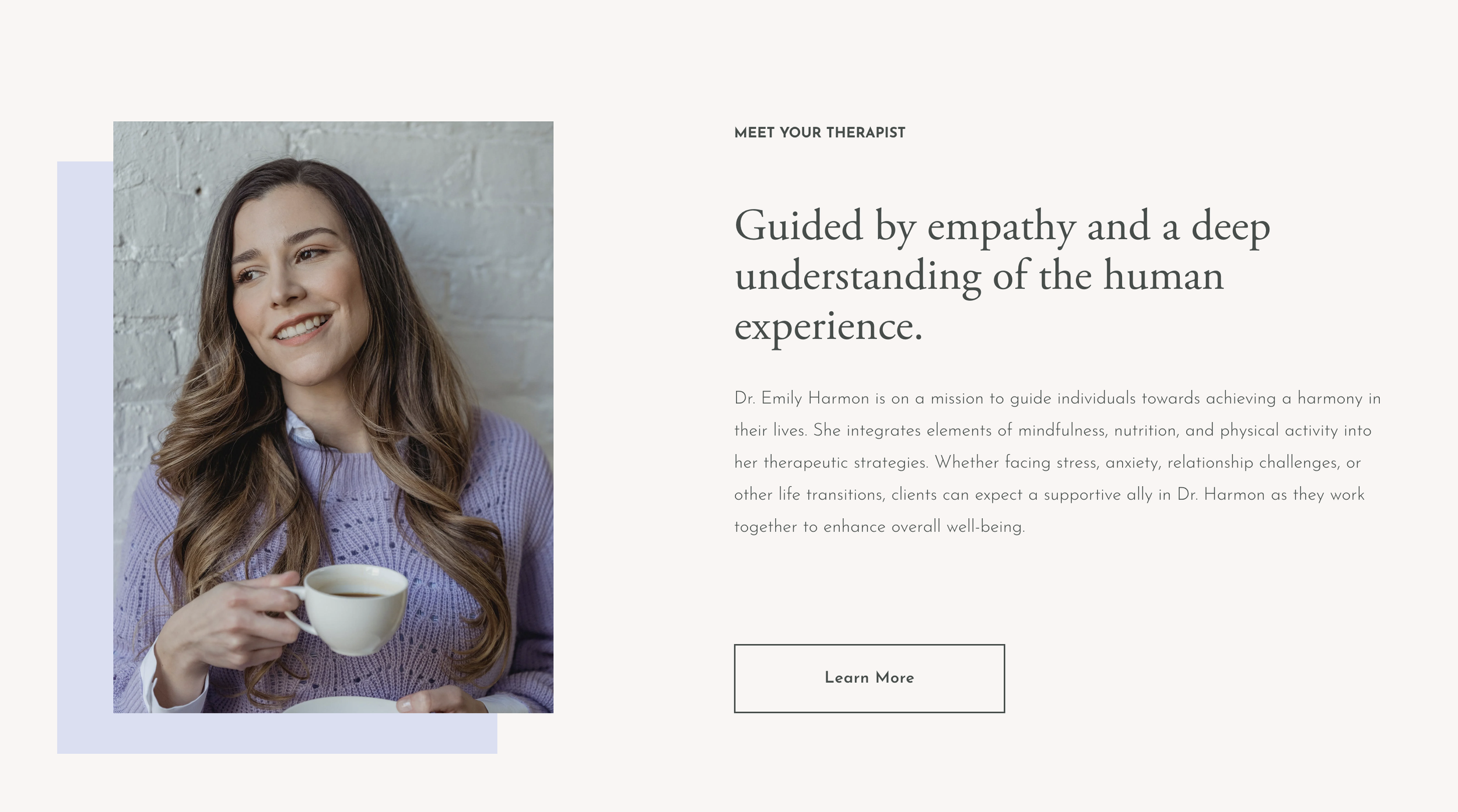
As a therapist, it is vital to show your face and introduce the human behind the practice early on. This copy should bridge the gap between "who I am" and "how I can help you." It’s less about your resume and more about your alliance with the patient.
The Copy Framework
Subhead: Licensed Therapist & Holistic Wellness Expert in [Location/Online]
Headline: Helping you navigate life’s transitions with a grounded, whole-body approach.
Body Copy:"I believe therapy is most effective when we look at the whole person, not just the symptoms. I’m Dr. Emily Harmon, and I partner with individuals to bridge the gap between mental clarity and physical well-being. Together, we’ll move past 'just getting by' and start building a life that feels genuinely harmonious."
SEO Formulas for Section 2
To maximize search visibility while maintaining a human touch, use these:
The Subhead (Keyword & Geo-Targeting): [Credential/Role] + [Primary Specialty] in [City/Location or "Online"]
Example: Licensed Clinical Psychologist & Trauma Specialist in Seattle.
The Headline (Transformation & Value): [Action Verb] + [Target Audience] + [Primary Result]
Example: Helping Overwhelmed Professionals Find Clarity and Lasting Emotional Balance.
Section 3: The Services
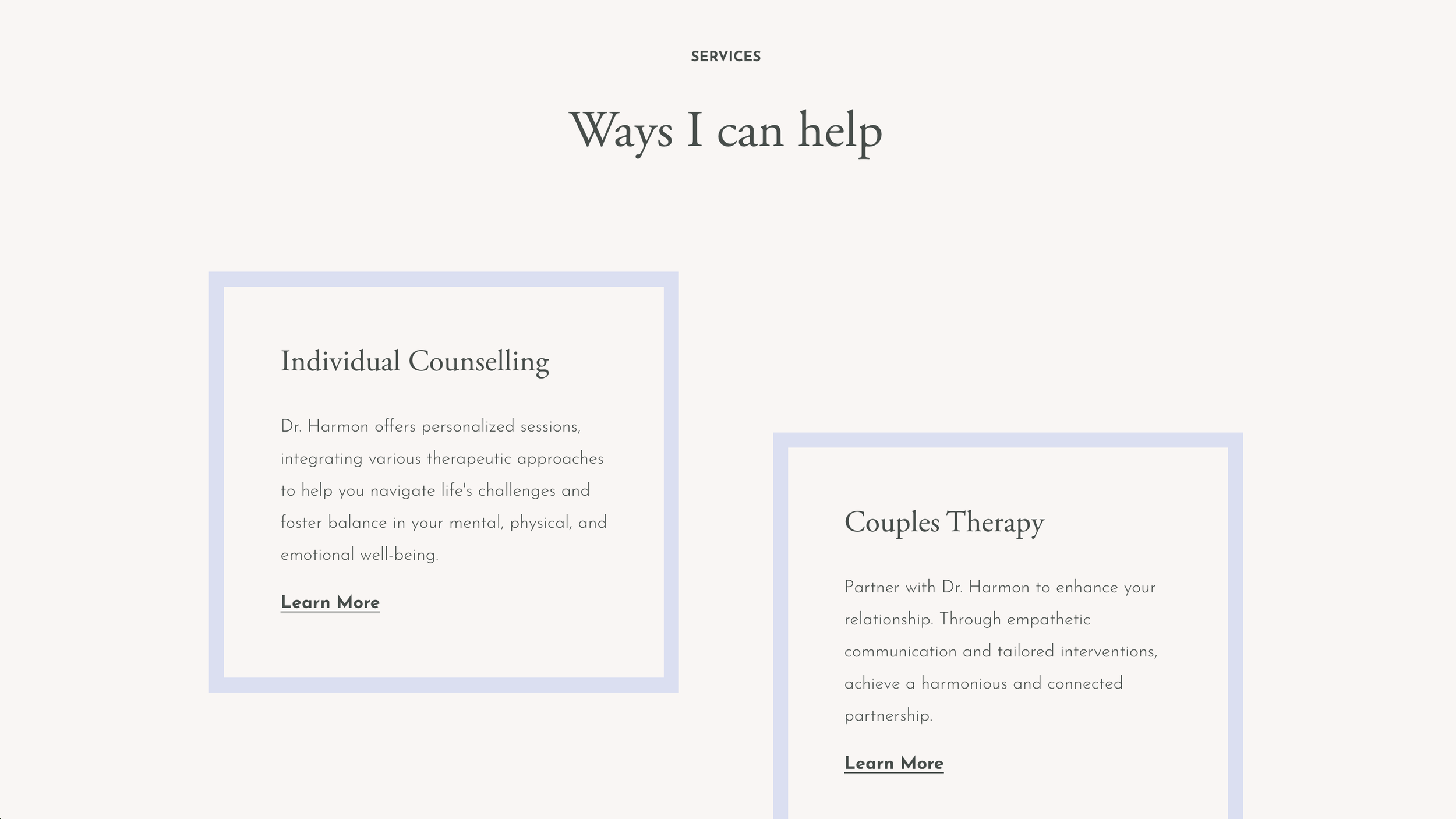
Now that people know who you are, they need specifics. Enter your core services. Frame these in a way that moves away from "clinical jargon" and toward "client benefits."
1. Visual Layout Recommendation
Limit yourself to 3 or 4 services. Highlighting the work you love most helps attract your "ideal" clients.
Visuals: Use icons or images for each service. People scan before they read; a heart icon for couples therapy or a leaf for wellness helps the brain categorize information instantly.
2. SEO Tip: Descriptive Headers
"Individual Counseling" is a high-volume but competitive keyword. Try being more specific:
Standard: Individual Counseling
SEO-Optimized: Individual Counseling for Anxious Professionals
3. The Service Card Template
Use this formula to write your descriptions:
[Service Name] + The Hook: Are you feeling [Specific Emotion]? + The Process: In our sessions, we will use [Modality] to... + The Result: ...so that you can finally experience [Desired Outcome].
4. Addressing the "Price" Dilemma
Pros: Filters out clients who can’t afford your rate, saving you time on consultations.
Cons: Might scare off clients who would be willing to pay once they understand your value.
The Middle Ground: Use a "Rates start at $XXX" line or a link to a dedicated "Fees & Insurance" page.
Section 4: The Invitation (The "How It Works")
By this point, the reader is interested but likely feeling vulnerable. This section is a "bridge" that explains the onboarding process to lower the barrier to entry.
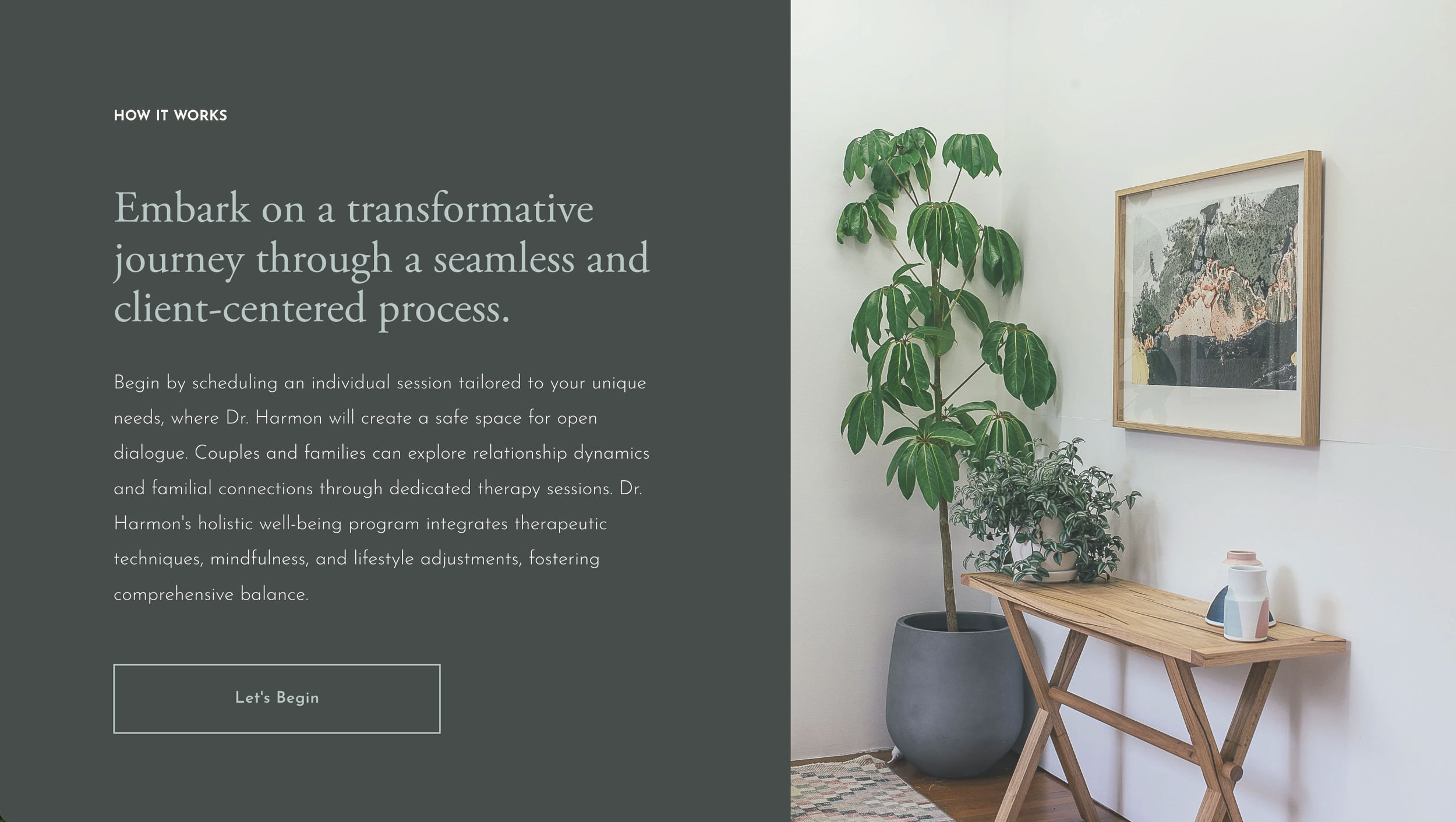
Paint a Simple 3-Step Picture
Show that the path to starting is easy to reduce "cognitive load" for stressed visitors:
Subhead: STARTING YOUR JOURNEY
Headline: Three simple steps toward a more balanced life.
Step 1 (The Connection): Reach out to schedule a free 15-minute consultation. We’ll chat about your goals and see if we’re a good fit.
Step 2 (The Strategy): In our first session, we’ll dive into your story and create a personalized plan.
Step 3 (The Transformation): Through consistent sessions, you’ll gain the tools to navigate life with confidence.
Button: Schedule Your Consultation
Section 5: The Final CTA (The Safety Net)
This is your closing argument. It should address the final "what if" in the reader's mind and provide a soft place to land.

The "Safety Net" Strategy
Address curiosity, offer a low-bar invite, and explain the "why."
Headline: Let’s find out if we’re the right fit.
Body: It’s normal to feel nervous about starting therapy. A free 15-minute consultation is a chance for us to connect and see how I can support you—with no obligation to book further.
Button: [Schedule Your Free Call]
Final Trust Signals
Wrap up the page with a human touch:
A "Warm" Sign-off: A handwritten-style signature (e.g., Warmly, Dr. Emily) humanizes the site.
Professional Badges: Place greyscale logos of certifications or insurance providers (e.g., Psychology Today, HIPAA Compliant) here as a "seal of approval."
Final Pro-Tip: If your button says "Book Now," it should lead to a live calendar (like Calendly or SimplePractice). If you are linking to a contact form instead, use "Inquire" or "Let's Connect" so the user doesn't feel misled by the extra step!
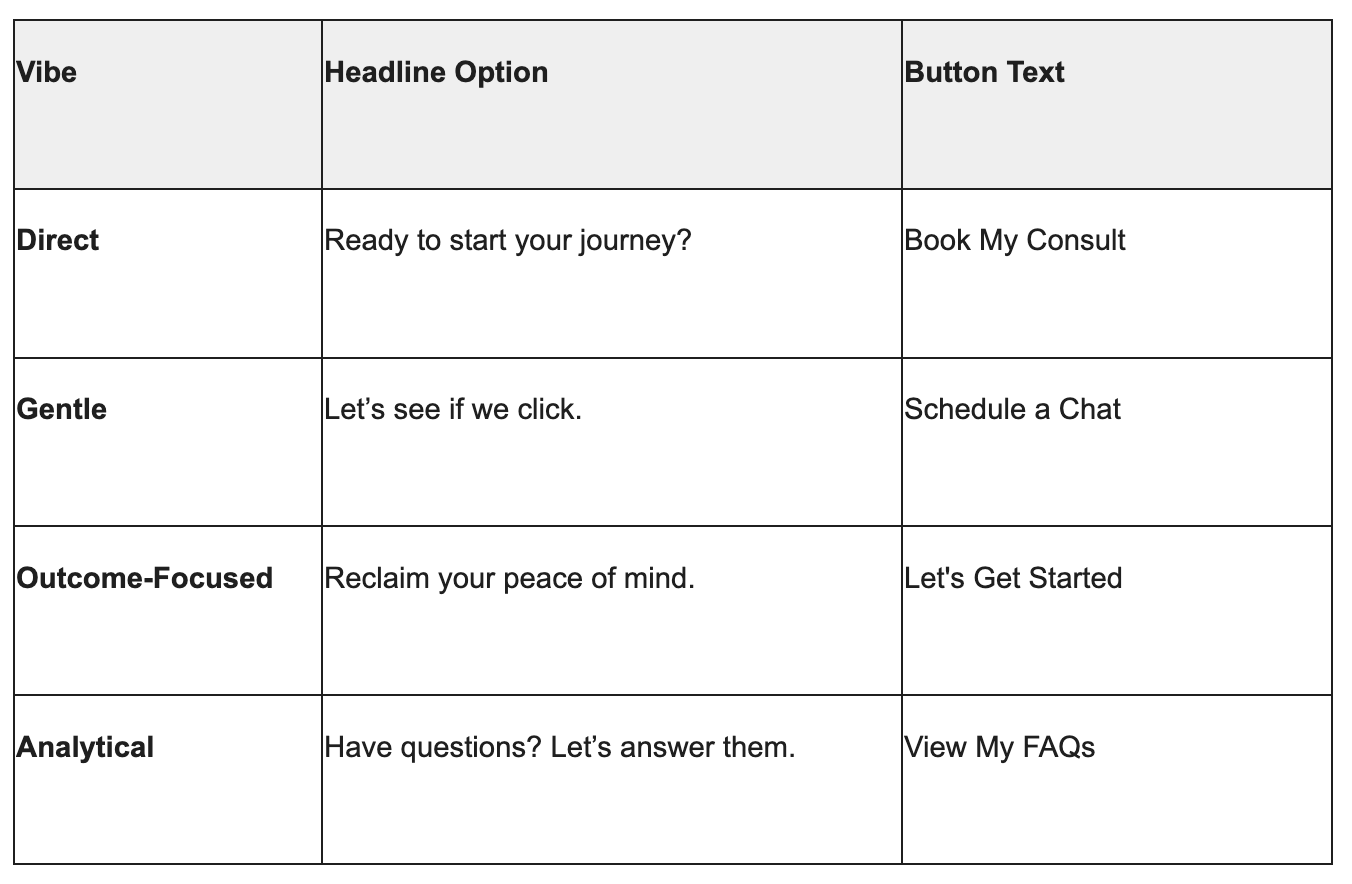
Strong CTA’s that Invite People to Reach Out
Choosing the right CTA’s can be tricky, so here’s a template you can pull from to help you choose a strong CTA that fits your vibe:
I hope this article helps you build a strong homepage for your business. Thanks for reading!
Be sure to check out our Squarespace template for therapists — it’s a great website template that will give your practice a professional home base online, and it’s already built for you!
